Logo

Make Your Dog A Therapy Dog

We provide you with a quick and convenient way to get an emotional support animal letter (ESA Letter) for your therapy dog in the UK and EU from £49.

✓ Apply 24/7 with no appointment necessary
✓ Suitable for Landlords, housing associations, entertainment facilities, and workplaces
✓ Certificates signed by a fully-registered UK Doctor
✓ Sent to your inbox by 9 a.m. with overnight service

LET'S GET STARTED Icon Icon

Get your medical certificate delivered straight to your inbox from £37

LET'S GET STARTED Icon Icon

Emotional Support Animal (ESA) Certificate

An Emotional Support Animal Letter (esa letter uk) is a document that verifies the need for an emotional support animal as part of a person’s treatment for a disability or mental health impairment.

Our medical practitioners can issue a hassle-free ESA certificate on the same day or overnight, straight to your inbox.

This certificate will confirm the details of your animal as well as your disability and how it affects you.

Apply online now.


LET'S GET STARTED Icon Icon
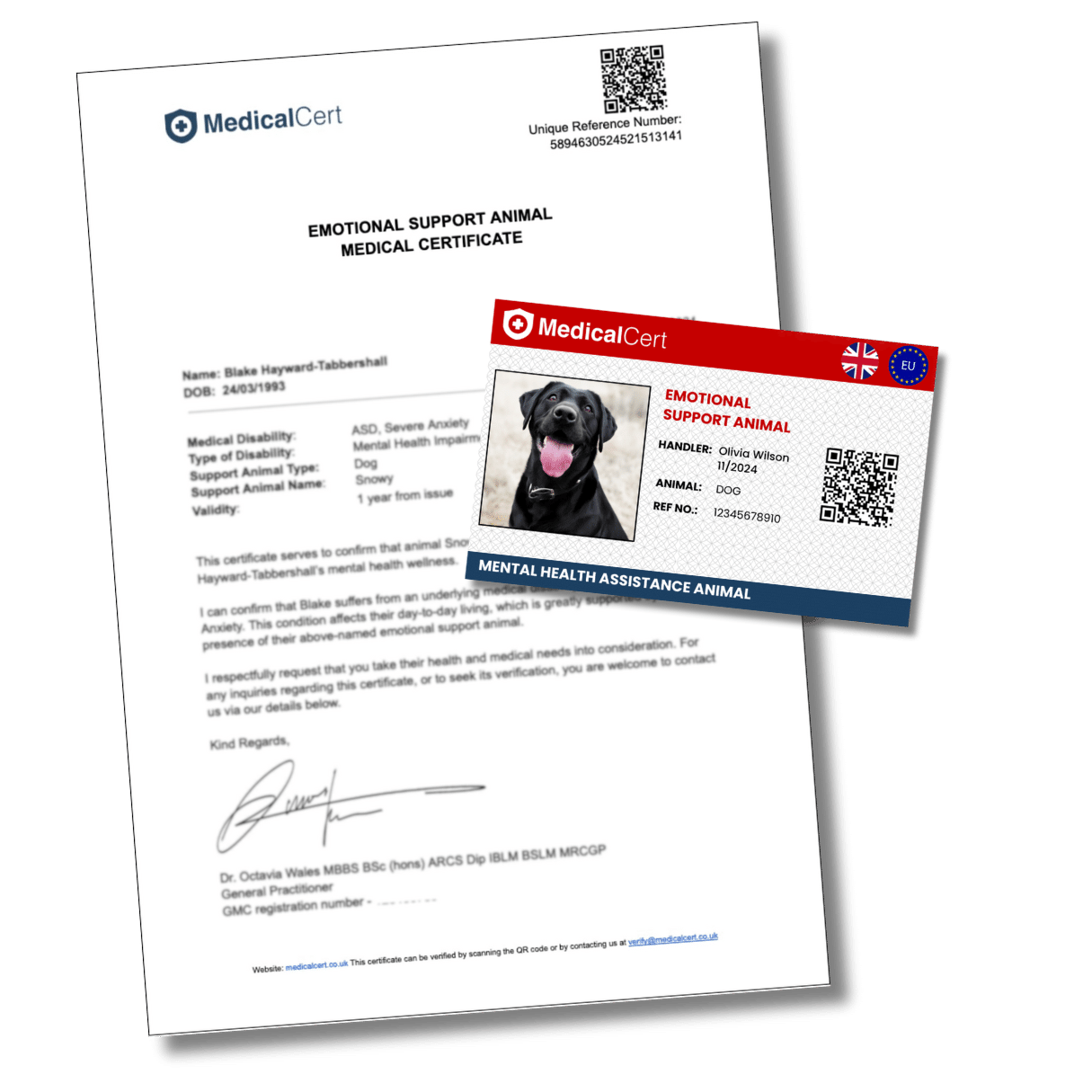
http://ESA%20letter%20certificate%20and%20card

What will you receive?

You will obtain a verifiable digital PDF Emotional Animal Support certificate and optional digital card bearing the signature of a registered medical doctor, sent directly to your mobile device. This document will include the following information:

✓ Confirmation of your emotional support animal and type.
✓ Your name and DOB
✓ Details of your mental health concern or disability and how it affects you.
✓ Signed and authorised by one of our GMC-registered UK doctors.
✓ Your certificates unique reference number and QR code for verification.
✓ Optional digital photo-card to carry on your phone (+£10).

How it Works

01

Complete a short online form

Simply complete a consultation form with the details of your animal and your disability. Upload a 30 second video explaining how your animal assists in your disability, as well as medical documentation of your condition.

doctor GP

02

Doctor Reviews Application

One of our FCDO and GMC registered GPs will review and validate the submitted information. Once approved they will sign an official ESA certificate and ESA card for you.

medical certificate medical letter sick note

03

Receive your certificate

Receive your emotional support animal (ESA) certificate as soon as same day or next working day, straight to your inbox. If we cannot provide you with a certificate for any reason, you'll automatically receive a full refund.


LET'S GET STARTED Icon Icon

PRICING

DELIVERY TO INBOX

£49

 ✅ Next day delivery before 9AM.

 ✅ Delivered to your inbox.

 ✅ Signed by a fully registered GP.

UK Guide — Therapy Dogs & Emotional Support Animals

How to Make Your Dog a Therapy Dog in the UK

Therapy dogs bring measurable comfort to people in hospitals, schools, care homes, and mental health settings. But becoming a recognised therapy dog involves specific training, temperament assessment, and — for owners who personally rely on their dog for mental health support — separate clinical documentation. This guide explains both pathways clearly.

  • Understand the difference between therapy dogs, assistance dogs, and emotional support animals under UK law
  • Learn the traits and training required for therapy dog certification
  • Understand when an ESA letter is needed and what it covers in the UK

UK Legal Definitions

Therapy Dogs, Assistance Dogs & ESAs: Key UK Distinctions

These three roles are frequently confused. In the UK, each has different legal status, training requirements, and rights of access. Understanding the difference matters before choosing a path.

Type Who they help Training required UK legal access rights
Therapy dog Many people — in hospitals, care homes, schools Obedience, temperament assessment, organisation certification No automatic public access rights — visits arranged through organisations
Assistance dog One individual with a disability Extensive specialist task training Full legal access rights under the Equality Act 2010
Emotional support animal (ESA) One individual’s mental health needs No formal task training required No automatic public access rights. ESA letters may support housing and some other accommodation requests
Important UK legal note: Unlike in the USA, the UK has no legislation equivalent to the Americans with Disabilities Act that grants ESAs specific public access rights. Only formally trained assistance dogs hold protected rights under the Equality Act 2010. ESA letters can support housing requests and some discretionary accommodation, but do not guarantee access to public spaces, transport, or workplaces.

Therapy Dogs

What Is a Therapy Dog and Where Do They Work?

A therapy dog is a calm, certified canine that visits multiple people in organised settings — working alongside a trained handler to provide comfort, reduce anxiety, and support wellbeing.

NHS & Hospitals

Therapy dog visits reduce patient anxiety, lower blood pressure, and support recovery — particularly in long-term wards, stroke rehabilitation, and mental health units.

Care Homes & Hospices

For residents with dementia or those facing end-of-life care, therapy dog visits provide meaningful sensory connection and emotional comfort that staff visits alone cannot replicate.

Schools & Universities

Therapy dogs support children with reading anxiety, exam stress, and social difficulties. Many UK universities now run therapy dog programmes during assessment periods.


Temperament

What Traits Does a Therapy Dog Need?

Not every dog is suited to therapy work — and that is fine. The assessment process is designed to identify dogs that will genuinely thrive in these environments, not just tolerate them.

Calm demeanour

Therapy dogs must remain settled in unfamiliar environments — quiet hospital rooms, busy school corridors, or slow-paced care home visits.

Genuine friendliness

Must approach strangers willingly and enjoy being touched, held, and petted without reservation — even by people who move unexpectedly.

Obedience and reliability

Sit, stay, come, and loose-lead walking must be consistent and reliable — not just in training settings, but in stressful or distracting environments.

Confidence without anxiety

A therapy dog cannot be easily startled by unfamiliar sounds, smells, or equipment such as wheelchairs, IV lines, or medical monitors.

Patience with all types of people

Patients with dementia may repeat the same gesture. Children may be unpredictable. The dog must remain calm and responsive throughout.

Good health and grooming

Regular veterinary health checks and grooming are essential — therapy dogs visit immunocompromised patients where hygiene standards must be high.


Training & Certification

How to Train and Certify a Therapy Dog in the UK

There is no single government-mandated certification path in the UK. Reputable therapy dog organisations run their own assessment programmes — most require passing a temperament and obedience evaluation before accepting dogs onto their visiting programmes.

1

Build a Foundation in Basic Obedience

Before any therapy assessment, your dog must reliably follow sit, stay, down, come, and loose-lead walking. Enrol in a reputable accredited training class if you have not already. Positive reinforcement methods produce the most durable and stress-free results.

2

Invest in Wide Socialisation

Therapy dogs must cope with wheelchairs, walking frames, medical equipment, crowds, and unpredictable movement. Controlled socialisation across varied environments — hospitals, public transport, busy streets — prepares dogs for real visits. This takes months, not weeks.

3

Choose a UK Therapy Dog Organisation

UK-based organisations including Therapy Dogs Nationwide, Pets As Therapy (PAT), and the Society for Companion Animal Studies run structured assessment and volunteer programmes. Each has its own assessment criteria — research which is the right fit for your dog and intended visiting environment before applying.

4

Pass the Temperament Assessment

Most UK therapy dog organisations conduct formal temperament and obedience assessments. The assessment tests how your dog responds to strangers, unusual handling, unexpected sounds, and other dogs. Dogs that are anxious, reactive, or inconsistent are not passed — this protects both the dog and the people they would visit.

5

Begin Supervised Volunteer Visits

Once accepted, visits are coordinated by the organisation and typically supervised initially. Many facilities — hospitals, care homes, and schools — have their own requirements for dogs entering, including up-to-date vaccinations and health records. Regular re-assessment is required by most organisations.


Emotional Support Animals

If You Personally Rely on Your Dog for Mental Health Support

If you have a diagnosed mental health condition and your dog provides you with therapeutic support — rather than visiting others — you may benefit from an emotional support animal (ESA) letter rather than therapy dog certification. These are separate pathways.

What an ESA letter covers in the UK
  • An ESA letter is issued by a GMC-registered doctor or licensed mental health professional confirming that your animal provides clinically relevant support for a diagnosed condition.
  • It can support housing requests — many UK landlords and housing associations will consider ESA documentation when making decisions about pet policies.
  • It is not the same as an assistance dog registration and does not grant automatic public access rights under the Equality Act 2010.
  • There is no official UK government registry for emotional support animals. Any website charging for “ESA registration” is not providing a legally meaningful service.
  • ESA letters are issued subject to clinical review — they may be declined where a clinical basis is not established.

If you are considering getting an emotional support dog for your own mental health needs, our guide to training an emotional support dog covers the practical steps in detail.


For Handlers

Making Therapy Visits Work Well

The dog’s welfare and the quality of the visit both depend on the handler reading the situation accurately.

Know Your Dog’s Stress Signals

Yawning, lip-licking, looking away, and tense body posture are early signs of stress. Leave before these escalate. A well-run therapy visit is positive for the dog, not just endured.

Keep Visits Short and Frequent

Shorter, positive visits are more effective than long ones that fatigue the dog. Build visit length gradually as your dog gains confidence in the environment.

Maintain Up-to-Date Health Records

Vaccinations, flea and worm treatments, and annual vet checks must be current. Many facilities require sight of health records before allowing visits. Grooming before each visit is expected.

Follow the Organisation’s Protocol

Always ask before approaching individuals. Respect the wishes of patients, staff, and residents. Do not offer treats without permission. Follow any infection control requirements set by the facility.


FAQs

Common Questions

Can any breed become a therapy dog?

Breed is less important than individual temperament. Many different breeds — including Labradors, Golden Retrievers, Cavalier King Charles Spaniels, and crossbreeds — work successfully as therapy dogs in the UK. What matters is the individual dog’s character: calm, friendly, confident, and genuinely comfortable with strangers. Some organisations may have breed-specific considerations based on their insurer’s requirements — check with your chosen organisation before applying.

How long does therapy dog training take?

Most dogs require several months of consistent training and socialisation before they are ready for a therapy dog assessment. The timeline depends on the dog’s starting temperament and existing training level. Dogs with solid obedience foundations who have been widely socialised from a young age typically progress faster than adult dogs starting from scratch. There is no value in rushing this — premature entry into therapy visits is stressful for the dog and unhelpful for the people being visited.

What is the difference between a therapy dog and an emotional support animal in the UK?

A therapy dog visits multiple people in organised settings to provide general wellbeing support — the dog’s handler volunteers with an accredited organisation. An emotional support animal is a personal companion for one individual with a diagnosed mental health condition. ESAs do not require task training and are supported by a clinical letter rather than a therapy organisation assessment. The two roles and their documentation are completely separate.

Does my dog need an ESA letter to work as a therapy dog?

No. An ESA letter is for the owner’s personal mental health needs — it is not part of therapy dog certification. Therapy dogs are certified through UK-based therapy organisations such as Pets As Therapy or Therapy Dogs Nationwide. If you personally have a mental health condition and your dog also supports you, you may benefit from both — but these are separate documents with different purposes.

Is there an official UK register for therapy dogs or ESAs?

No. There is no government-run official registry for either therapy dogs or emotional support animals in the UK. Therapy dog certification comes from private organisations (Pets As Therapy, Therapy Dogs Nationwide, etc.). ESA status is supported by a clinical letter from a licensed professional — not by registration on any database. Any website selling “official ESA registration” or “therapy dog registration certificates” without clinical assessment is not providing a legally meaningful service. Be cautious of such claims. For a legitimate UK ESA letter, clinical assessment by a registered professional is required.


Need an ESA Letter for Your Dog?

If your dog provides emotional or mental health support to you personally, a GMC-registered UK doctor can assess your case and issue an ESA letter where clinically appropriate — no appointment needed.

Apply for an ESA Letter

Medical Cert is a service of Nobel Medical LLC. ESA letters are issued subject to individual clinical review by a GMC-registered doctor. An ESA letter does not confer assistance dog status or automatic public access rights under the Equality Act 2010.